|
Our February worship gathering was led by Lisa and Leah; and the theme was love - not romantic love, but love for the world, and in particular love of place, this place where we gather for worship. Our readings for reflection include these two:
My help is in the mountain Where I take myself to heal The earthly wounds That people give to me I find a rock with sun on it And a stream where the water runs gentle And the trees which one by one give me company. So must I stay for a long time Until I have grown from the rock And the stream is running through me And I cannot tell myself from one tall tree. Then I know that nothing touches me Nor makes me run away. My help is in the mountain That I take away with me. - Mary Wood Psalm 96: 11-12 Let the heavens rejoice, let the earth be glad; let the sea resound, and all that is in it. Let the fields be jubilant, and everything in them; let all the trees of the forest sing for joy. What you love about a particular place or the wild world in general. What are the things that you love most about being in nature, about being outside amongst the more-than-humans? What does it do for your spirit? How does it change you? What gifts does it offer you? Where do you feel loved by the wild world?
0 Comments
Our January worship gathering focused on the theme of Refuge/Refugia. Winter is a season when we, and the creatures and plants around us, seek refuge from the harsh elements. It is also a metaphor for challenging and stressful times, like the times we live in with climate disasters, wars, and polarization. Our winter book study is on the book Refugia Faith: Seeking Hidden Shelters, Ordinary Wonders, and the Healing of the Earth by Debra Rienstra. Refugia is a biological term that describes little pockets of safety, hidden shelters in harsh conditions or times of disaster and crisis, where life persists and out of which new life emerges. Author Debra Rienstra writes: “... even amid destruction, the forces of life yearn for renewal. A refugia faith, similarly, regards our dire conditions honestly but immerses fear and despair in longing for God's promised new life.” (p 31) Refugia are places to find shelter, but only for a time - they are not an escape or a place to stick our heads in the snow and ignore the realities of life. More importantly, refugia are places to begin, places where the tender and harrowing work of restoration and renewal takes root. Winter doesn’t last forever; trees don’t stay in dormancy forever; animals don’t stay in hibernation or in their burrows forever; birds don’t stay in their winter nesting grounds forever. We can create places of refuge to protect us and renew us through the hardest times, and then launch from there into the next season or stage of regrowth. Psalm 46 says “God is our refuge and strength, a very present help in trouble. Therefore we will not fear, though the earth should change…” Where do you see places of refugia in the world around you? Where do you go to seek refuge? As this year turns to the next,
Bless the passing of time, God, whether we like it or not. Bless children growing right before our eyes, our ageing bodies and ageing parents. Bless the presence of each moment, and the movement of hours turning into days, weeks, months, seasons, years, lifetimes. For the year behind us, may we be graced with memories. Give us hearts large enough to hold heartaches, resilient enough to accept losses, and content enough to be grateful. For the year ahead, give us open hands and open minds. Help us embrace growth and beauty, unknowing and paradox. Bless the good earth who grounds us, and horizons that give us space to see. Bless the sun who travels the globe each day, and the moon whose change night by night is perceptible. Bless the water with is many forms, modelling change and transformation. Bless the sky and its moods, brilliant and drab and everything in between. Bless us with rituals that bring shape and meaning to our days. Bless us with companions who provide connection and comfort. Bless us with hope in a future with light, love, and laughter. - Wendy Janzen 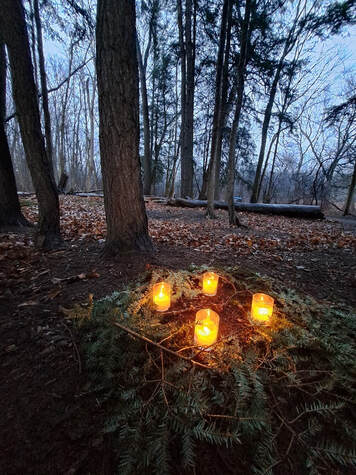 Our December worship gathering, as always, combined themes from the Advent season and the coming winter solstice. It is no coincidence that we celebrate Advent when we are at the darkest point of the year in the Northern Hemisphere. The return of the sun symbolizes the coming of the Light of the World, Emmanuel: God With Us.
While we want to be mindful of not polarizing light and dark, or demonizing darkness, we do acknowledge that there is destruction and brokenness in the world; as a result all of us, and all of creation is in need of hope and healing. This is what we celebrate as we light candles and wait for the sun’s shift back toward lengthening days. Just as there are different types & stages of light, twilight, and darkness, we experience light and darkness differently in our own lives. The intensity of darkness varies. Perhaps it is a constant companion - one you are more or less comfortable with. Perhaps it is a veil that you long to have lifted. Both light and dark play important roles in our lives and in creation. “Sing, starry sky and every constellation, for what the Eternal One has done. Shout for joy, dark soil underfoot and deep caverns below; Erupt in joyful songs, mountains and forests, and every tree in them! Sing joyfully, for the Eternal One has rescued Jacob; the splendor of God will be revealed...” (Isaiah 44:23, The Voice) Leah invited us into a time of wandering with this invitation: "Sometimes when I enter into our wandering & wondering times, I find having a phrase or words to repeat to myself…kind of like a mantra. So today I offer you the opening line of the song The Sound of Silence by Simon & Garfunkel, which says 'Hello Darkness, my old friend'. We invite you to use that phrase as an invitation to lean into the darkness today during your wanderings & wonderings." After wandering and sharing with each other, we listened to this song Find the Light by David Ramirez as we lit candles. Our closing blessing was A Blessing for Traveling in the Dark by Jan Richardson: Go slow if you can. Slower. More slowly still. Friendly dark or fearsome, this is no place to break your neck by rushing, by running, by crashing into what you cannot see. Then again, it is true: different darks have different tasks, and if you have arrived here unawares, if you have come in peril or in pain, this might be no place you should dawdle. I do not know what these shadows ask of you, what they might hold that means you good or ill. It is not for me to reckon whether you should linger or you should leave. But this is what I can ask for you: That in the darkness there be a blessing. That in the shadows there be a welcome. That in the night you be encompassed by the Love that knows your name. - in Circle of Grace: A Book of Blessings for the Seasons, Jan Richardson Touching on themes of incarnation and epiphany, our January worship gathering reminded us to pay attention to God’s sacred presence among us. God’s incarnation was not a one-time event. Epiphany was not a one time event. They are archetypes of how God is active and present in a variety of forms in the world - showing up in human form, in all creation, in stars, on journeys into unfamiliar territory.
Matthew 2:9b-10 “...they (the Magi) set out, and there, ahead of them, went the star that they had seen in the east, until it stopped over the place where the child was. When they saw that the star had stopped, they were overwhelmed with joy.” All that the magi had to illuminate and guide their way was a star and a dream. Their journey to encounter holiness began with a burning light, with a step taken, with companions gazing in the same direction. As we stand near the beginning of this new year, what is guiding you? What are you noticing? How are you following your longing to encounter holiness? Which direction is calling you? What are you giving your attention to? Who are your companions on the journey? A blessing for heading into December and Advent
Blessed be the darkness, protecting, covering, comforting. Blessed be the early evenings, and long nights. Blessed be the moon and stars, and monochrome landscapes. Blessed be the deep stillness and inner quiet. Blessed be the hope held in the shadows, beneath the ground, and deep in the belly. - Wendy Janzen To breathe the fresh morning air,
To observe the variety of tracks in the snow, To greet the crow flying overhead, To hear the joyful chirping of birds, To admire the silhouette of an old tree in front of the rising sun, To feel the bright, warm sun on my cold skin: This is to be alive and to remember I am not alone. - Wendy Janzen I've been in a bit of a writing slump. So for the month of February I took on the spiritual practice of writing one (or more) six-word sermons each week, based on time spent out in creation. I'd encourage it as a simple way to focus and synthesize your thoughts and reflections from time spent outdoors, or whenever/wherever you spend your contemplative time.
Here are the five I shared on our social media streams this month: Below the snow, seeds await spring. God's here in our winters, too. Love shines on all God's creatures. Every day let kindness burn bright. Be rooted in peace, not war. God, our constant companion and guide,
here in this place of stark beauty, make your sacred presence felt among us. Open our senses and our full awareness to your mystery, and help us to listen to the seeds buried in the earth, to the interplay between water and ice, to the cold wind in the bare branches, to the stillness of the trees, to the brilliance of the sky, to prayers without words. Amen. May God bless the season of winter around us and within us. May we go, knowing God's presence in the midst of life’s challenges, God's love in the stillness, and God's hope in the promise of new life waiting for spring. Amen. - Wendy Janzen Blessed be the Light
that bursts forth, illuminating new paths, enlightening new thoughts. May this Epiphany season be filled with dreams and signs. May your imagination take you beyond what you thought was possible. May you have the courage and vision to follow the Light into places of inspiration. - Wendy Janzen |
AuthorReflections, poetry, prayers, photos, and resources written by Wendy Janzen unless otherwise noted. Archives
July 2024
categories
All
|
 RSS Feed